How to Pick a School Assembly Students Remember
How to Pick a School Assembly Students Will Actually Remember (and Teachers Won't Dread)
The short answer: A good school assembly has a captain. The performer takes over the ship for an hour, and it is their job to keep every age level and every attention span on course.
One common thread runs through the whole show, so the kindergartner, the eighth grader, and the teacher in the back row all hear the same idea. Yes, the teachers too. They are half the room, and they are watching to see if you can hold it.
The best school assemblies stick in your head instead of lecturing at you.
Look for a program that fits your grade range. Most acts run 30 to 60 minutes. Most people who take the stage at school assemblies have a specialty, a niche. Mine is focus, failure, and what comes next.
Too many presentations talk at kids instead of with them. A message backed by live demonstrations is what captured my imagination as a child.
Every year we had a magician, a juggler, a dancer, a band. A school assembly came around about once a quarter, and it was always fun to see the wide variety of things out there that most kids never get to see. I will never forget when the magician came to our school.
Kids also love seeing their friends up on stage. So do the teachers, and yes, teachers get pulled up there too. My shows have lots of people on stage. I connect with an audience the way that 4th grade assembly connected with me. It sparked my dive into the variety of things I do now, and I love sharing them.
So whatever kind of assembly you are having, make it amazing.
Why Most School Assemblies Fall Flat
Most school assemblies have a problem. Forty minutes in, the kids in the back are building a rival civilization out of shoelaces.
That is not a behavior issue. It is a programming issue.
An assembly fails for one of three reasons:
It talks at kids. Students sit for a lecture dressed up in a costume.
It has no point. Fun for ten minutes, forgotten by lunch.
It ignores the room. The same script for kindergarten and eighth grade fits neither.
Fix those three and you have a program worth the gym floor.
What to Look for Before You Book a School Assembly
Not every educational assembly is created equal. Before making an elementary assembly booking, here are five things worth considering.
1. A Real Message, Not Just Noise
Ask what students will walk away knowing. "They'll have fun" is a weather report, not an answer.
A strong assembly can name its idea in one sentence. Mine is this: you can get better at hard things.
2. Live Demonstrations
Kids believe what they see.
When a performer drops a juggling pin on purpose and says "this is step one," every child who has ever been embarrassed at recess exhales.
Seeing the idea beats hearing about it.
3. Age-Appropriate Programming
A K-8 range is wide. Ask if the show adjusts for primary and intermediate students, or if the performer can run separate grade-level shows in one day.
Mine can.
4. Audience Participation
Students remember what they did.
Volunteers on stage, a whole room trying something together, a few laughs at the performer's expense. All good.
An interactive school assembly gives students something to participate in rather than simply watching from their seats.
5. Something Teachers Can Reuse
The best assemblies give classrooms a shared vocabulary.
When a teacher can say "remember the one-job rule?" three weeks later, the booking paid off.
What Student Focus Looks Like Live
Focus is not staring harder. It is giving your attention one job at a time.
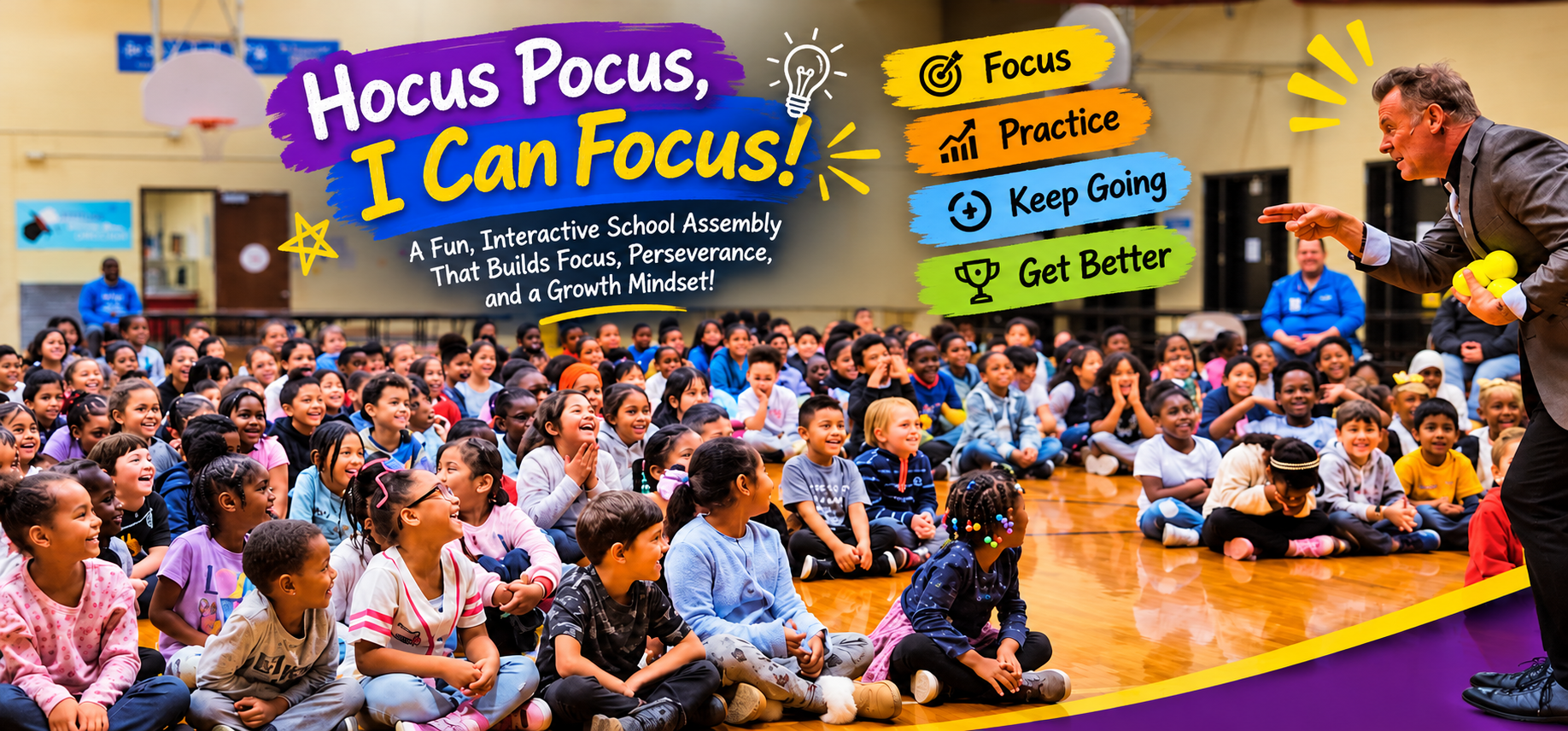
In the Hocus Pocus, I Can Focus assembly, students watch magic, juggling, and yo-yo tricks while seeing a simple path unfold.
Fail first. Focus on one thing. Practice until the hard thing turns familiar, then fun. Then look back and notice how much you can now do that you could not do before.
Fail. Focus. Flow. Fulfillment.
Four words, one stage, zero PowerPoint.
This connects to the executive function skills teachers already work on every day: sustained attention, handling frustration, and sticking with a task.
The show does not replace your classroom work. It gives it a boost and a funny memory to hang it on.
Why This Matters to Me
When I was in fourth grade, a school assembly changed what I did with my free time.
It sparked a dive into magic, juggling, yo-yo, and top spinning. I became the kid with a pocketful of skills and very little interest in sitting still.
I later became a classroom teacher, and I did my first school assembly while still in college. Since then I have traveled the country doing them.
Kids have told me they picked up magic, juggling, or yo-yo because of an assembly. That never gets old.
School Assembly Details for Planners
If you are organizing a school assembly, here are the practical details to help you plan.
Detail | Information |
|---|---|
Length | About 45 minutes |
Grades | K-8, with adjustments for elementary and middle school |
Format | Assembly show, or hands-on juggling and yo-yo workshops for smaller groups |
What you provide | A space, a microphone, and an audience |
Booking | Use the Check Your Date button. No payment is required to hold a date, and requests get a reply within one business day. |
Whether you are planning a school-wide event, an elementary school assembly, or a middle school enrichment program, the goal is the same: give students an experience they will remember long after they leave the gym.
Frequently Asked Questions About School Assemblies
How long is the Hocus Pocus, I Can Focus assembly?
About 45 minutes.
What grades is it for?
It works best for K-8. The show can be adjusted for elementary or middle school, or run as separate grade-level assemblies on the same day.
Is it entertainment or education?
Both. It is a magic and juggling show built around focus, perseverance, and learning that hard things get easier with practice.
Do you offer workshops?
Yes. Hands-on juggling and yo-yo workshops run about 45 minutes and suit smaller groups.
What do we need to provide?
A space, a microphone, and an audience. We confirm the rest at booking.
Where are you based?
Omaha, Nebraska, with performances across the country.
How do we hold a date?
Submit your preferred dates with the Check Your Date button. No payment is needed to hold it.
Ready to Give Your Students Something Worth Paying Attention To?
Give your students more than another presentation. Give them an interactive experience that combines magic, juggling, laughter, and a message they can carry back into the classroom.